

Spartanburg Capital Improvement Penny
Collected 2018-2024
Passed by voters in 2017, the original penny sales tax in Spartanburg County led to the construction of a new Spartanburg County Courthouse, a new Spartanburg Police Department headquarters, a new County Emergency Operations Center, and will fund the construction of a County-City Joint Government Center - the first of its kind in South Carolina.
Capital Improvement Penny FAQs (2018-2024)
-
The referendum featured a ballot question on Nov. 7, 2017.
Priority #1:
Replacement of current City of Spartanburg and Spartanburg County judicial facilities
(to include a new Spartanburg County Courthouse, City of Spartanburg municipal court/police facilities, Spartanburg County emergency operations center (currently located in the basement of the County Courthouse), and associated parking and infrastructure, in one or more structures)Cost: 151,519,154
Priority #2:
Replacement of current City of Spartanburg City Hall and Spartanburg County Administrative Building
(to include new joint use government center facilities to serve both the City of Spartanburg and Spartanburg County, and associated parking and infrastructure, in one or more structures)Cost: $65,326,428
Priority #3:
Road and Bridge Projects
(to include the then highest priority projects identified in the County’s Capital Improvement Plan after taking into account the availability of State and other funds)Cost: $7,554,418
Total: $224,400,000
-
The one cent sales tax passed by voters in 2017 began on May 1, 2018 and ended April 30, 2024.
-
No. The one cent sales tax did not apply to unprepared food (groceries), prescription medicines, gasoline purchases, certain maximum tax items such as automobiles, and sales of personal property otherwise exempt from State sales tax.
-
According to the South Carolina Revenue and Fiscal Affairs office, the additional one cent sales tax will generate approximately $37,421,097.00 per year. This estimate is prior to any adjustments made by the South Carolina Department of Revenue for administrative expenses.
-
State law requires that the one cent sales tax be used only for the projects listed on the ballot:
New Judicial Center
New Municipal Court/Police Building
New Emergency Operations Center
New Judicial Center parking garage
New City/County Government Center
New Government Center parking garage
Any remaining funds will be used for roads and bridges projects to include the then highest priority projects identified in the County’s Capital Improvement Plan after taking into account the availability of State and other funds.
-
According to the May 2017 report by Justice Planning Associates, Inc:
The Spartanburg County Judicial Center, which opened in 1958, is overcrowded and does not meet modern standards with respect to security or technology.
The building is unable to provide separate and secure zones for the public, prisoners, judges, jurors, and court staff. This creates a safety issue, as well as potentially compromises the integrity of the judicial process.
The building opened in 1958 with 3 courtrooms, and over time, that number has grown to 14 courtrooms. The added courtrooms are located in converted office space, with inadequate room dimensions and low ceiling heights.
The majority of problems cannot be fixed within the existing facility, regardless of the amount of money spent.
Other specific issues:
Overcrowded public and staff spaces
Most Courtrooms do not meet recommended standards
Inaccessible spaces for some members of the public, including witness stands, jury boxes, and jury deliberation room toilets
Lack of conferencing and victim waiting spaces near courtrooms
Prisoner detention spaces do not meet modern detention standards
Inadequate heating, ventilation, air conditioning, plumbing, and electrical systems
The buildings around the existing Judicial Center are also inadequate and cannot continue to support justice system functions. These buildings exhibit similarly poor spatial, operational, and physical conditions as the Judicial Center.
It has been recommended that the new Judicial Center remain on the existing site, and that any functions which support that building, or have a direct relationship, also be located on that site.
The building has experienced water intrusion problems in the past which the County has attempted to correct, but which are likely to continue to occur due to the building’s age and construction.
-
The existing City Hall and the County Administration Building, both constructed in the early 1960s, are more than 50 years old. Both facilities were built prior to modern codes and standards. Both facilities have physical issues that impact operating requirements. Those issues include: inappropriate accessibility for mobility-impaired persons; insufficient power and data supply for modern technology; and inadequate heating, ventilation, and cooling.
The County Administration Building is a former Sears Department store, which was adapted for governmental use. Although the building has served its purpose for approximately 30 years, there are issues with respect to public service, security, and availability of natural light. The building is experiencing structural problems to include water leaks and adequate ventilation. The most overcrowded spaces are those with the highest volume of public contact, such as the Assessor, Auditor, and Treasurer. The crowded conditions can result in extended wait times and loss of confidentiality.
Nearly all components in the City Hall are suffering from some degree of overcrowding, with the Police Department and Municipal Court in particularly inadequate space. Due to differences in the nature of operations, functions such as the Police Department, Fire Department, and Municipal Court are not typically co-located with general governmental administrative functions, such as the City Council, Mayor, and Finance.
-
PUBLIC SERVICE: A City/County government center will improve public convenience and enhance wayfinding for citizens. The public cannot always differentiate between County and City government services. Residents sometimes appear at the wrong building, resulting in confusion and frustration. A shared location would provide a single visible source of government for the public. However, some non-administrative services will continue to be satellited in other buildings, such as the Development Services Building and the Community Services Building, both as a way to provide efficient delivery of services to their particular customers, and as a cost-saving measure with respect to the new government center.
SHARED OPERATIONS: A co-located government center presents opportunities to share resources, such as public lobbies, training rooms, conference facilities, health clinics, IT server rooms, storage rooms, fire stairs, mechanical/electrical spaces, public and staff toilets, snack bars, breakrooms, and other areas. Collocation can also facilitate communication and coordination among the various government functions.
SHARED COST: According to Justice Planning Associates Inc, a City/County government center would be less expensive to construct than two separate facilities, and would be less costly to operate and maintain, securely and efficiently.
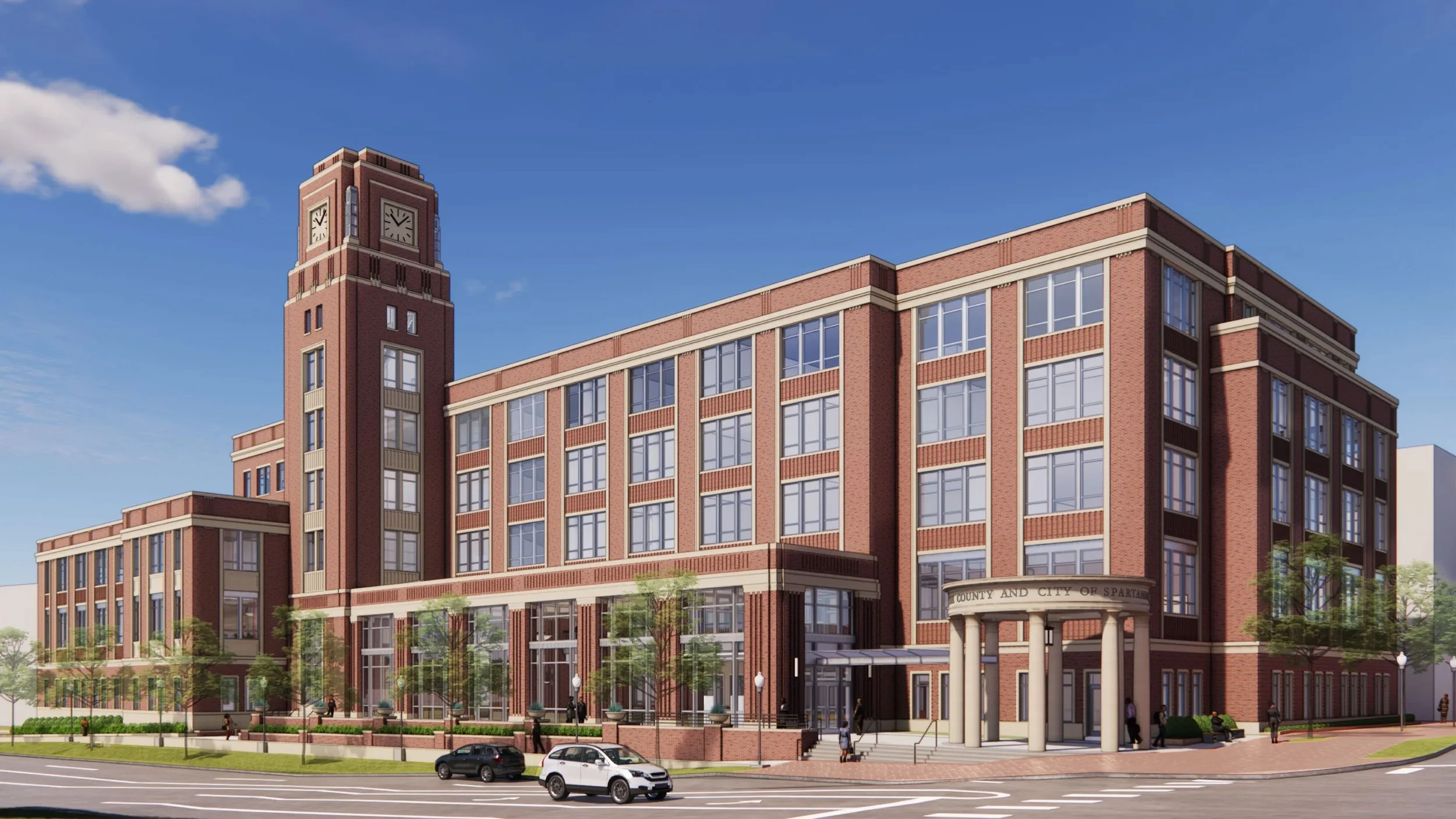
Spartanburg Joint Government Center
Construction of a 5-story administrative building to be shared by Spartanburg County and the City of Spartanburg was set to begin in October 2025.
The facility will be the first of its kind in the state of South Carolina, offering residents a “one-stop shop,” with services that before were located in multiple locations now coming under one roof.
Construction plans also call for a public and staff parking garage of 600 spaces.
County and City government leaders believe the new facility will make local government more accessible for the residents it serves.
Joint Government Center Progress Videos
March 13, 2026
February 9, 2026
Spartanburg County Courthouse
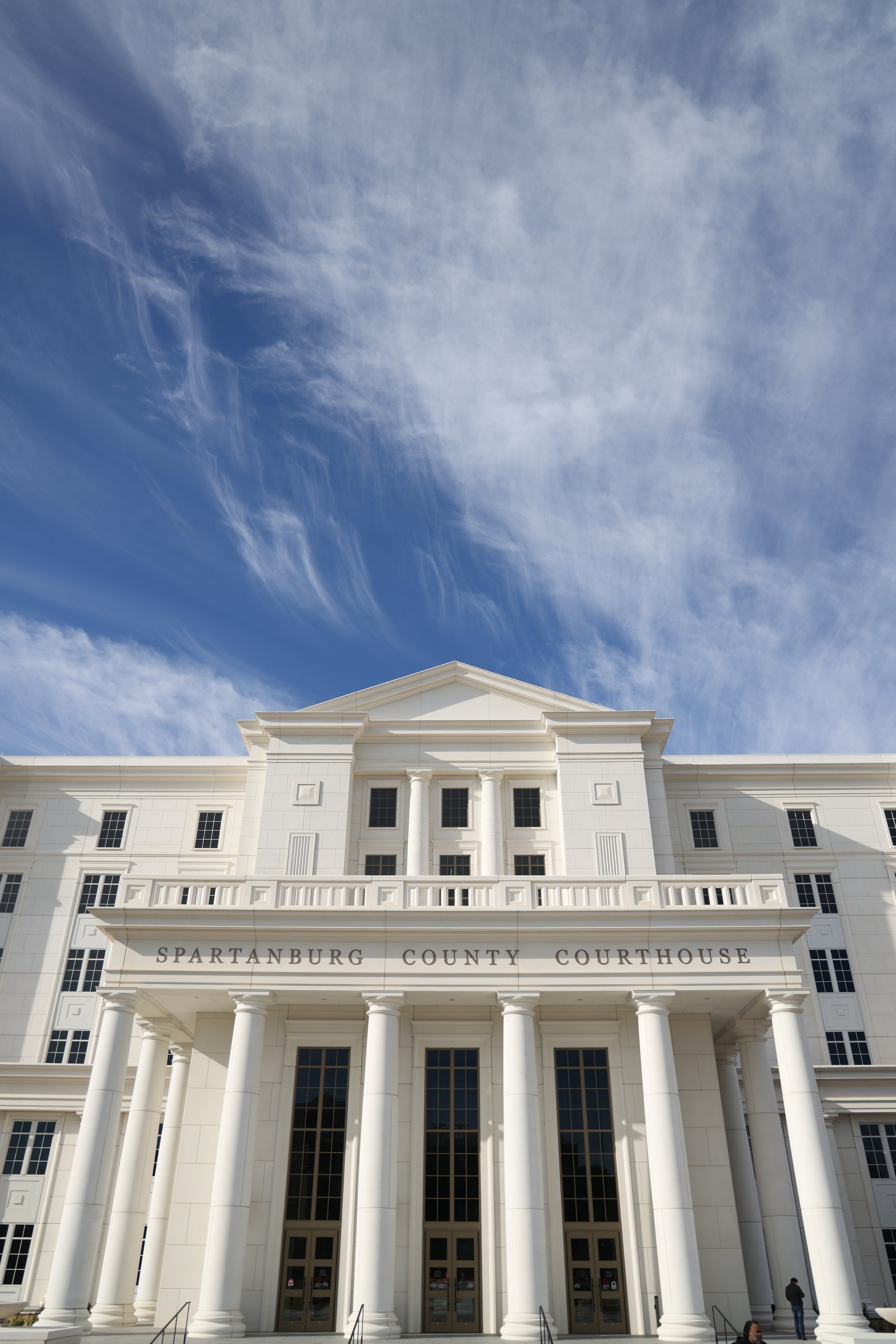
The approximately 340,000 sq. ft. Courthouse consolidates activities previously located in separate facilities. The six-story, $120-million facility was constructed with 17 courtrooms, 1 hearing room, jury-assembly room, jury-deliberation rooms, and shell spaces for future use in the event of necessary expansion.
The courts are organized symbolically based on the status of the courts with supporting offices and ancillary functions.
The office for the Chief Justice of the Supreme Court is located on the top floor, along with the Circuit Court, which is the court of general jurisdiction. Courts of limited jurisdiction include the Family Court, Probate Court, Magistrate Court, and Municipal Court.
Due to public volume and certain operating hours, the Municipal and Magistrate Courts are located lowest in the building, with the Family and Probate Courts occupying the middle floors.
Space is also provided for the various Clerk of Court functions, Sheriff Courthouse security and court holding, Solicitor, Public Defender, Juvenile Justice, Guardian ad Litem, and other ancillary support components.
Spartanburg County Emergency Operations Center
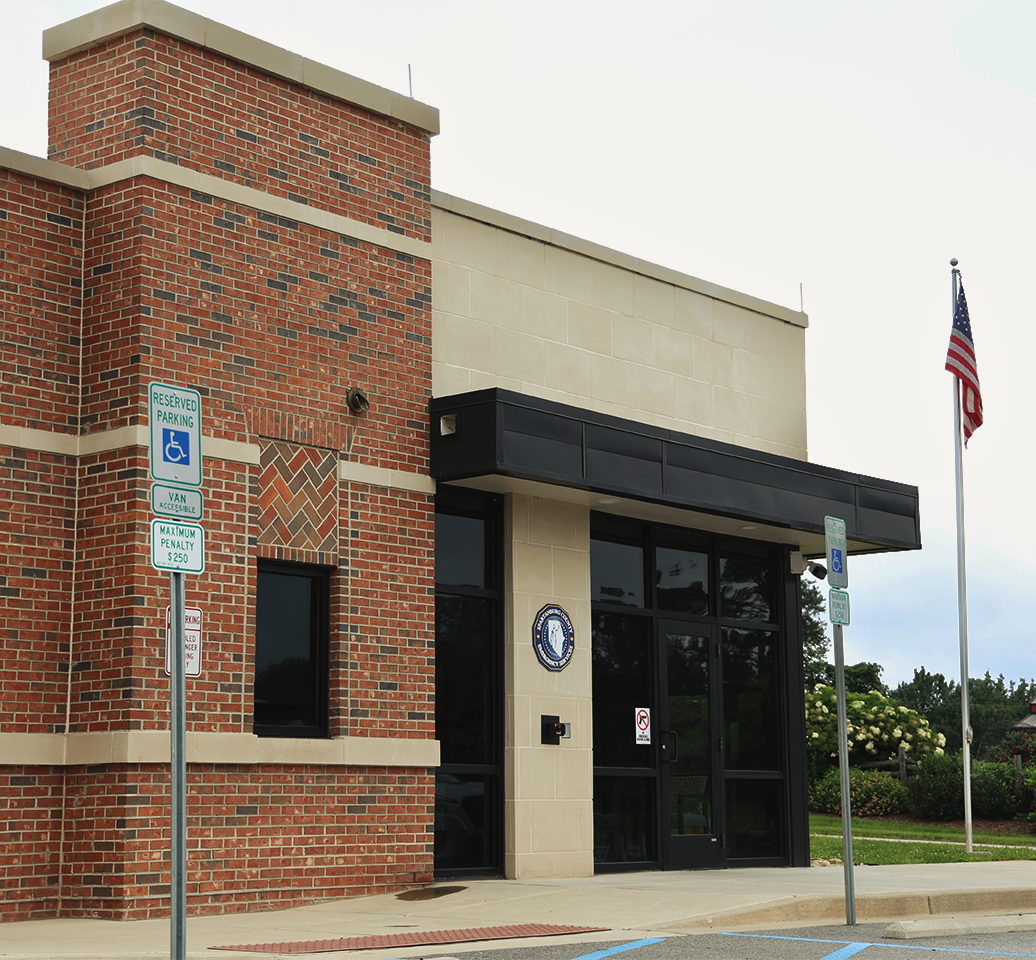
The Spartanburg County Emergency Operations Center (EOC) is an 18,000 sq. ft. facility that houses Emergency Management Services, the Emergency Operations Center, Hazardous Materials operations, and the county’s alternate 9-1-1 call center.
One of the goals of the $5.6-million facility was to provide better geographical separation between primary and alternate 9-1-1 centers to lessen the likelihood both facilities could be impacted by a natural or man-made disaster. The new facility is also closer to the intestate to aid access for emergency personnel.
Spartanburg Police Department HQ
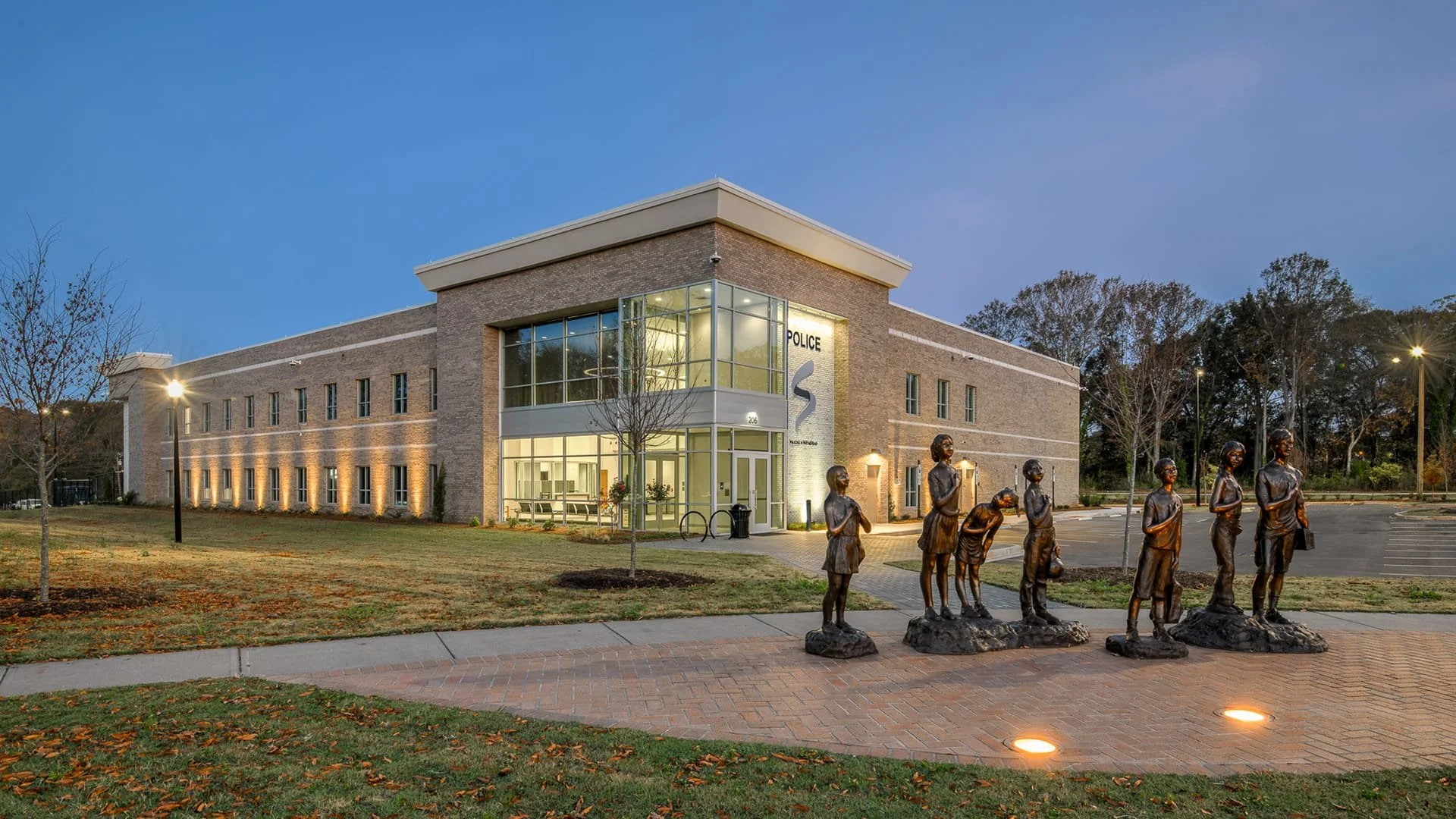
The new, $13.1-million headquarters for the Spartanburg Police Department is approximately 45,000 sq. ft. at the intersection of St. John and Wofford streets.
The new building provides the department an upgrade in space and technological capabilities from its previous location, inside the old Spartanburg City Hall building.
Spartanburg Capital Penny (2018-2024) Facts & Figures
-
Spartanburg was founded as a "courthouse village," a spot chosen solely to locate a courthouse for frontier disputes. The current courthouse remains the center of town today.
The size of the new Courthouse is approximately 340,000 sq. ft., which is more than 3 times the size of the current courthouse and equivalent to nearly 6 football fields.
The $120 million Courthouse is 6 stories and 124' tall.
The new Courthouse has 713 total rooms, including 17 courtrooms.
There are 996 doors and 138 windows in the new Courthouse.
The Capital Penny Projects will support 1,839 jobs.
The Penny Projects have an expected economic impact of about $240 million, including $60 million from visitors.
The total number of pre-cast panels on the outside of the new Courthouse is 1101. Some panels weigh as much as 50,000 pounds.
There is 82 miles of cabling inside the new Courthouse.
The wood used on the Courthouse job site was sourced from Cameroon.